Choosing a storage unit sounds simple until you actually have to decide how much space you need. Most people want to avoid two problems. The first is paying for more room than necessary. The second is renting a unit that feels full before everything is inside. If you have been asking yourself, “what size storage unit do I need?”, you are in the right place.
At Minify Self Storage, this is one of the most common questions people have before renting. The good news is that choosing the right fit does not have to be a guessing game. Once you break your items down by type, quantity, and access needs, the answer becomes much clearer.
This guide will help you compare common storage unit sizes, understand what typically fits in each one, and choose a space that makes sense for your move, cleanup project, or long-term storage needs.
The right unit size can save you money, reduce stress, and make your storage experience much easier. A unit that is too small can lead to a frustrating move-in day, wasted time, and the need to upgrade later. A unit that is too large may give you more space than you need, which can mean paying more than necessary.
That is why it helps to choose based on your actual belongings, not just a rough guess. A little planning now can save you from a headache later.
Before comparing storage unit sizes, make a quick inventory of what is going into the unit. The number of items matters, but so does the type of items.
Boxes are often the easiest thing to underestimate. Ten boxes may not seem like much until they are stacked together with lamps, bins, bags, and other loose household items. If most of what you are storing is boxed up, you may be able to use your space more efficiently, especially if the boxes are uniform and stack well.
Furniture changes everything. A couch, mattress, dining table, dresser, desk, or shelving unit can take up a lot of room quickly. Bulky items also make a unit harder to pack tightly, especially if they are awkwardly shaped or fragile.
If you are storing appliances, business inventory, tools, equipment, or items you may need to access later, it is smart to leave yourself more breathing room. A unit that looks big enough on paper can feel much smaller once large items are inside.
When people search for storage unit sizes, they are usually looking for a practical answer, not just dimensions. Here is a simple breakdown of the most common unit sizes to help you match your needs with the right fit.
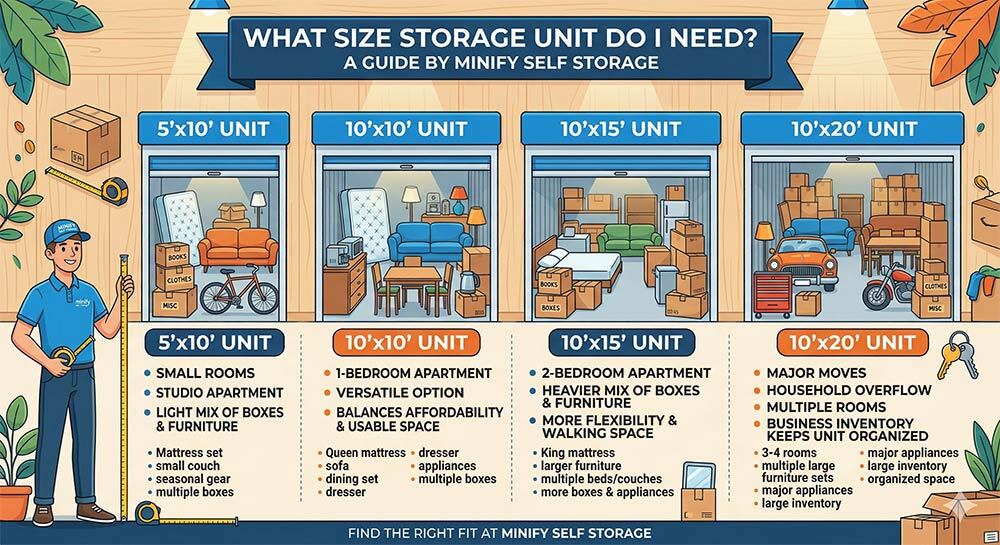
A 5x10 storage unit is often a strong option for people who need to store the contents of a small room, a studio apartment, or a light mix of boxes and furniture. This size can typically hold several boxes, a mattress set, a small couch, chairs, shelving, and seasonal items.
If you are clearing out a bedroom, storing overflow from an apartment, or making room during a move, a 5x10 may be enough. It is a good choice when your storage needs are modest but still include more than just a few boxes.
A 10x10 storage unit is one of the most versatile options because it works well for many everyday storage situations. It is often the right answer for people wondering what size storage unit for a 1 bedroom apartment makes the most sense.
In many cases, a 10x10 can hold the contents of a one-bedroom apartment, including a mattress set, sofa, dining set, dresser, appliances, and multiple boxes. If you are between sizes, this is often where people find the best balance between affordability and usable space.
A 10x15 unit gives you more flexibility for larger storage needs. This size is often a better fit for the contents of a two-bedroom apartment or a home with larger furniture pieces. If you have a heavier mix of boxes, furniture, and appliances, or if you want a little room to move around inside the unit, this size can be a smart step up.
For people searching what size storage unit for a 2 bedroom apartment, a 10x15 is often a safer choice than trying to squeeze everything into something smaller.
A 10x20 storage unit is ideal for major moves, household overflow, larger furniture sets, or business storage. If you are storing items from multiple rooms, downsizing, renovating, or combining personal and business belongings, this size gives you more room to work with.
It is also a better option if you want to keep the unit organized over time instead of packing everything tightly from floor to ceiling.
Two people with the same number of items may still need different unit sizes. That is because storage is not only about quantity. It is also about how those items fit together and how you plan to use the space.
If your items are mostly sturdy boxes and bins, you can usually maximize the vertical space. But if you have fragile décor, irregular furniture, or oddly shaped items, efficient stacking becomes harder.
Some people plan to load the unit once and leave it alone. Others need to return for documents, seasonal décor, business supplies, or personal items. If you need access later, leaving a narrow walkway can make a huge difference. That may push you into the next size up.
Short-term storage during a move may allow for tighter packing. Long-term storage usually benefits from better organization, clearer access, and a bit more space to prevent damage and frustration.
Many renters start with one reason for storage, then add more items over time. Maybe you are in the middle of a move, cleaning out a garage, helping a family member, or remodeling part of your home. If that sounds likely, planning for a little extra room is often worth it.
Sometimes the right choice is not the smallest unit your belongings can technically fit into. Sometimes it is the unit that lets you move in with less stress and use the space more practically.
Going one size up makes sense when:
you are right on the edge between two sizes
you have bulky furniture or awkward items
you want easier access later
you expect to add more belongings over time
That extra space can make loading simpler, help protect your belongings, and save you from needing to change units later.
One of the most common mistakes is choosing based only on price instead of fit. Saving a little on monthly rent does not help if the unit is too cramped to use properly.
Another common mistake is forgetting to measure large items. Couches, mattresses, dining tables, and appliances often take up more usable space than expected. People also forget to think about future needs. A unit that fits today may feel too small a month from now.
The other big mistake is packing so tightly that nothing is accessible. If you need to get to anything inside the unit later, that approach gets frustrating fast.
If you are still unsure what size storage unit you need, that is completely normal. A lot of people are estimating space for the first time, and it is easy to overlook how much room furniture, boxes, and everyday household items can take up.
The best storage unit is the one that fits your belongings comfortably, supports how you plan to use the space, and gives you confidence on move-in day. At Minify Self Storage, choosing the right fit starts with understanding what you are storing and how much access you want later.
If you are comparing storage unit sizes and want help making the right call, contact Minify Self Storage and we can help you choose a unit that fits your needs without the guesswork.
